15 Best Places To Visit In Germany This Winter

As participants in Amazon Associates and other programs, we earn from qualifying purchases. This comes at no additional cost to you. For more details, see our Affiliate Disclosure.
Winter casts a special spell over Germany, making it a fantastic time to visit. If you’re looking for the best places Germany winter has to showcase, or planning your Germany winter travel destinations, you’ll find plenty of appealing options. Germany is world-renowned for its enchanting Christmas markets Germany hosts in almost every town, but the country offers many other winter activities Germany visitors enjoy, from snowy mountain escapes to cozy city breaks.
The shorter days bring twinkling lights, the aroma of spiced mulled wine (Glühwein), and a unique atmosphere. Whether you seek fairytale castles dusted in snow, festive city squares, or alpine adventures, Germany in winter is ready to welcome you.
Berlin
Berlin, Germany’s dynamic capital, is a city steeped in history, art, and culture. It offers countless museums, historical sites like the Brandenburg Gate, and diverse neighborhoods.
Winter brings numerous holiday markets scattered across the city, each with its own character. It’s also a great time to explore world-class museums on Museum Island without the large summer crowds and enjoy the city’s vibrant indoor cultural scene.
Munich
Munich is the capital of Bavaria, known for its beer halls, beautiful parks like the English Garden, and proximity to the Alps. It blends traditional Bavarian charm with a modern, sophisticated feel.
Visit in winter for the famous Christmas market on Marienplatz, right in front of the stunning Neues Rathaus (New Town Hall). Munich also serves as a great base for day trips to the snowy Bavarian Alps for skiing or sightseeing.
Nuremberg
Nuremberg, in Bavaria, has a rich medieval history. It’s known for its Imperial Castle, well-preserved old town walls, and connections to the Holy Roman Empire and World War II history.
Winter is synonymous with Nuremberg’s Christkindlesmarkt, one of Germany’s oldest and most famous Christmas markets. The atmosphere, traditional prune figures (Zwetschgenmännle), and delicious Nuremberg gingerbread (Lebkuchen) make it a must-visit.
Dresden
Dresden, the capital of Saxony, sits on the Elbe River. It’s often called ‘Florence on the Elbe’ due to its stunning Baroque architecture, much of which was rebuilt after WWII, including the Frauenkirche.
Winter highlights Dresden’s beauty, especially during the Striezelmarkt, Germany’s oldest confirmed Christmas market. Seeing the opulent Baroque buildings like the Zwinger Palace dusted with snow is truly magical.
Cologne
Cologne is a major city on the Rhine River in western Germany. Its defining landmark is the massive twin-spired Cologne Cathedral, a UNESCO World Heritage site.
Winter brings several charming Christmas markets, including one set against the backdrop of the magnificent Cathedral. The festive atmosphere along the Rhine River and in the cozy pubs of the Old Town makes Cologne very inviting during the colder months.
Hamburg
Hamburg is Germany’s second-largest city and a major port on the Elbe River. It’s known for its maritime spirit, canals, the Speicherstadt warehouse district, and vibrant nightlife.
Winter sees Hamburg host various unique themed Christmas markets, from traditional to quirky. The illuminated Speicherstadt (warehouse district) looks particularly atmospheric on dark winter evenings, and indoor attractions like Miniatur Wunderland are perfect escapes from the cold.
Rothenburg ob der Tauber
Rothenburg ob der Tauber is a world-famous medieval walled town on Germany’s Romantic Road in Bavaria. It looks like it’s straight out of a storybook with its half-timbered houses and cobbled streets.
Winter enhances Rothenburg’s fairytale atmosphere, especially if it snows. The town holds its traditional Reiterlesmarkt (Christmas market), and wandering the medieval walls and quiet streets feels incredibly romantic and historic during this season.
Garmisch-Partenkirchen
Garmisch-Partenkirchen is a Bavarian mountain resort town near the Austrian border. It lies at the foot of the Zugspitze, Germany’s highest mountain, and hosted the 1936 Winter Olympics.
This is a prime destination for winter sports enthusiasts. Enjoy excellent skiing and snowboarding on the Zugspitze and surrounding areas, or take the cable car up for breathtaking panoramic views of the snow-covered Alps. The town itself is charming with traditional painted houses.
Harz Mountains
The Harz Mountains are a low mountain range in central Germany, known for their forests, folklore (especially relating to witches and the Brocken peak), and historic mining towns.
Winter transforms the Harz into a snowy wonderland. Ride the historic narrow-gauge Brocken steam train up through the snow-covered forests for spectacular views. The region offers opportunities for cross-country skiing, winter hiking, and exploring charming towns like Quedlinburg and Goslar.
Black Forest (Schwarzwald)
The Black Forest is a large forested mountain range in southwestern Germany, known for its dense evergreen forests, picturesque villages, cuckoo clocks, and thermal spas like Baden-Baden.
Winter covers the Black Forest in snow, creating beautiful landscapes perfect for winter walks or snowshoeing on marked trails. Cozy up in traditional guesthouses, visit charming villages like Triberg (famous for waterfalls that can freeze), or relax in the region’s famous thermal spas.
Füssen / Neuschwanstein Castle
Füssen is a Bavarian town on the Romantic Road, serving as the gateway to the famous Neuschwanstein and Hohenschwangau castles built by King Ludwig II.
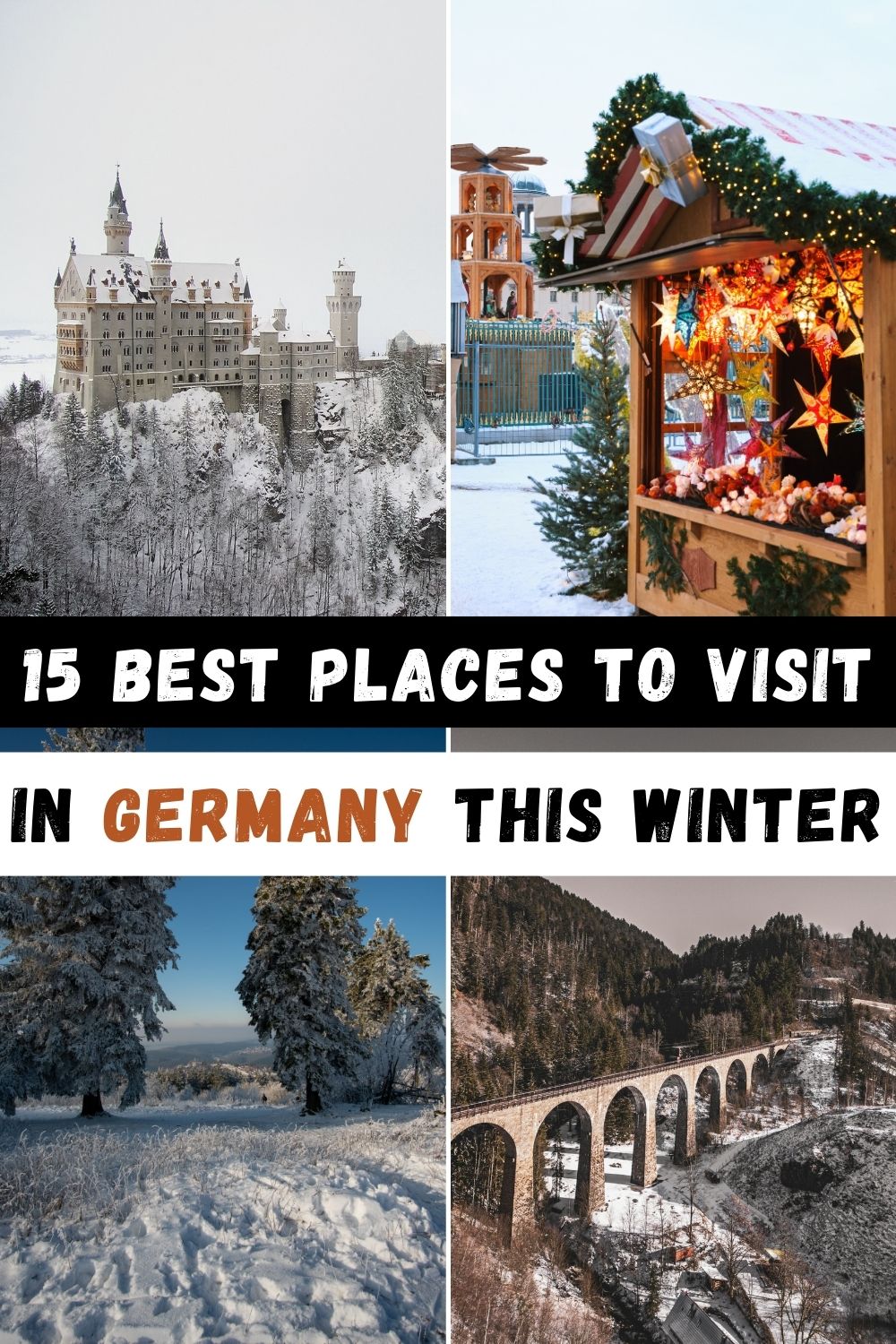
Seeing Neuschwanstein Castle covered in snow is an unforgettable, truly magical sight, looking even more like a fairytale palace. Winter offers clearer views and fewer crowds than peak summer season, making the experience more special.
Leipzig
Leipzig, in Saxony, is a city with a rich cultural history, particularly linked to music (Bach, Wagner, Mendelssohn worked here) and pivotal events like the Peaceful Revolution of 1989.
Winter is ideal for enjoying Leipzig’s cultural offerings indoors, from concerts at the Gewandhaus to museums. Its historic Christmas market, dating back to 1458, is one of the largest and most beautiful in Germany, set against the backdrop of the Old Town Hall.
Quedlinburg
Quedlinburg, in the Harz Mountains region, is a stunning UNESCO World Heritage site. It boasts over 1,300 well-preserved half-timbered houses spanning several centuries and a beautiful castle complex.
Winter is special here because of the unique “Advent in den Höfen” event on Advent weekends, where private courtyards of historic houses open up to host small, charming market stalls. The entire town feels incredibly atmospheric with its half-timbered architecture dusted in snow.
Monschau
Monschau is a small, picturesque resort town nestled in the narrow valleys of the Eifel region near the Belgian border. It’s known for its slate-roofed, half-timbered houses lining the Rur River.
Winter brings a quiet charm to Monschau. The compact, romantic Christmas market fits perfectly within the historic town center. It’s a wonderful place for a peaceful winter escape, enjoying the scenery and the cozy atmosphere away from large crowds.
Heidelberg
Heidelberg is a charming university city on the Neckar River in southwestern Germany. It’s famous for its romantic cityscape, the ruins of Heidelberg Castle perched above the Old Town, and Germany’s oldest university.
Winter offers beautiful views of Heidelberg Castle overlooking the Neckar, potentially dusted with snow. The Christmas market in the Old Town adds festive cheer, and the romantic atmosphere of the city, with fewer tourists, makes it perfect for exploring the historic streets and riverside paths.